
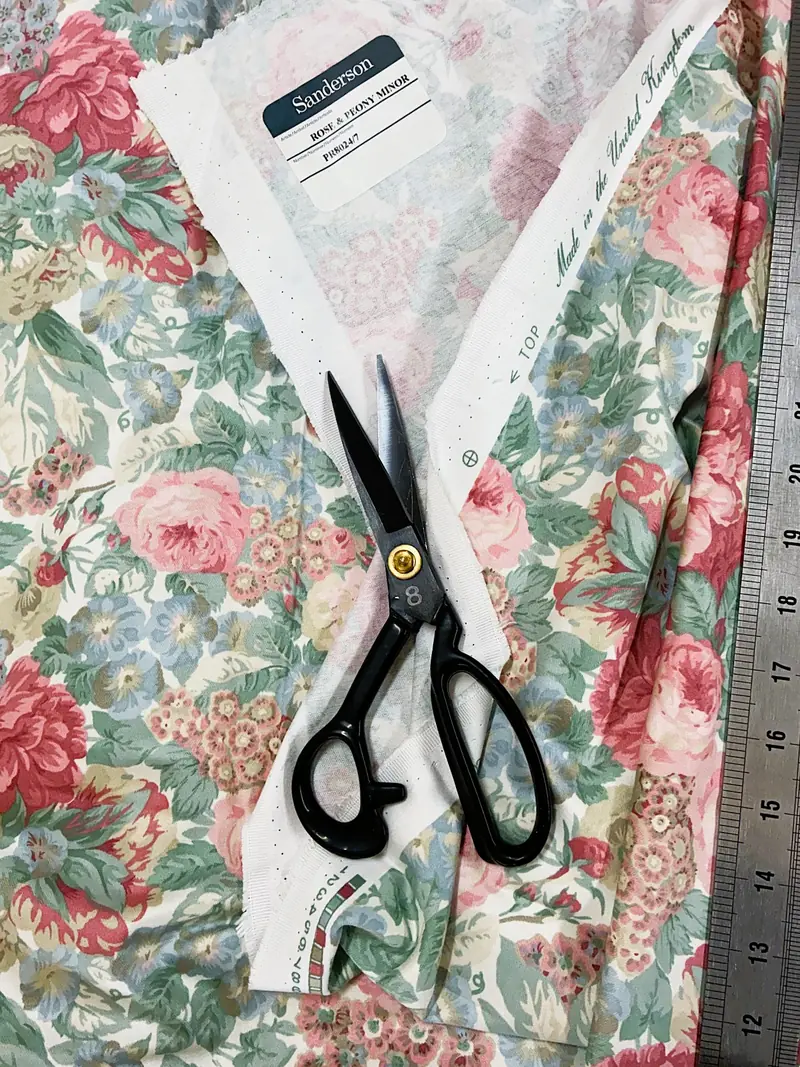
There is a particular kind of fabric that stops you — the kind where the colour has softened just past its original intention, where the pattern has a warmth to it that only comes from years of sitting in a window or folded inside a cedar chest. These are the fabrics we look for.
At Finch & Hatton, we don't buy fabric new. Every bolt, every metre, every remnant in our Canowindra workshop arrived with a history already attached to it — English chintzes from estate sales, French linens from deceased collections, Australian country-house drapery from the kind of house that had curtains up for forty years before anyone thought to replace them.
Finding them
It begins at markets and auctions and occasional tip shops, but it also begins with word of mouth. We've had fabric arrive from as far away as Broken Hill and Tasmania — sometimes just two metres of something extraordinary, sometimes a full bolt that someone's grandmother never quite got around to making up.
Not all of it is usable. Some fabrics arrive too far gone — sun-rotted, mildewed beyond recovery, the fibres too fragile to stitch. We assess everything by hand, holding it up to the light, testing the seam allowance, checking the back of the cloth for the original colour. It's slow work, and sometimes it's disappointing. But when you find a piece of 1960s Sanderson chintz with the selvedge intact and the colour still singing — that's something.
Restoring them
Every fabric we use goes through a careful wash. We use mild agents that won't strip the remaining colour, and we dry flat to preserve the hand. Some pieces need a gentle press. Some need a careful inspection for weaknesses in the weave before we cut.
We also match. Most vintage fabrics don't come in large enough pieces to cover a whole cushion front — that's part of their character. So we find complementary textiles: a linen back in a tone that honours the front, a velvet trim that deepens without competing, a zip in a colour that disappears into the seam.
Making them
The cutting is done by hand — no rotary cutters, no shortcuts. Each cushion is cut to honour the fabric's pattern, which means planning the placement before the first snip, and sometimes losing ten centimetres at the top so that a rose falls in the centre of the cover rather than drifting off to one side.
The sewing is done on our Singer — a machine old enough to have its own character, and precise enough to leave nothing to chance. We press every seam. We turn every corner. And when the zip is in and the insert is stuffed and the whole thing is sitting on the workbench, there's a moment before we photograph it where we just look at it for a while.
That's the second life. That's what this is all about.