
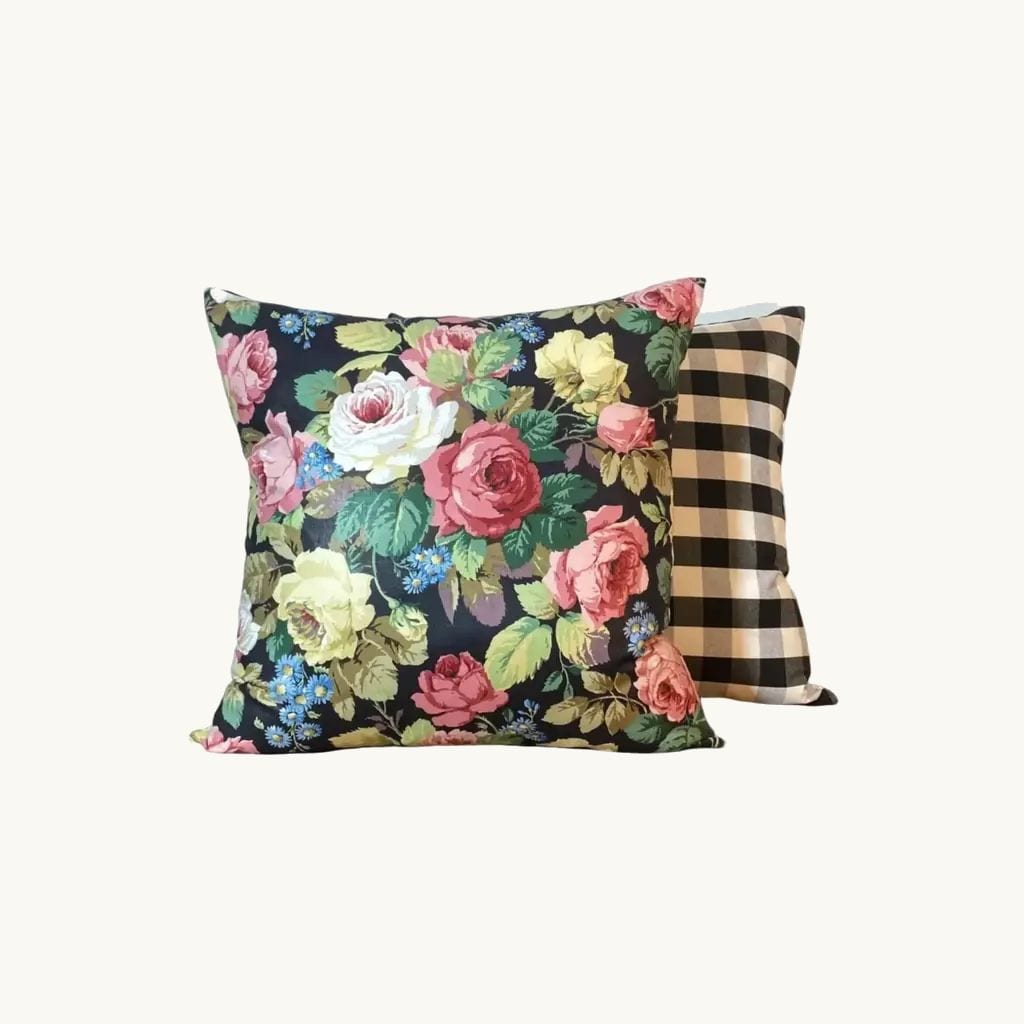
Almost everything we sew began as something else. Curtains from a house clearance. A bolt someone bought in the seventies, put in a cupboard, and never cut. A loose cover that outlived its armchair. A good share of what comes through the workshop carries a Sanderson selvedge, and that name is the reason a length of fabric older than we are can still become a cushion worth having.
What furnishing fabric actually is
Sanderson has been printing furnishing fabric and wallpaper in England since the nineteenth century, and the word furnishing is doing the work in that sentence. Furnishing cloth is woven heavier than dress cotton, because it was made for curtains and loose covers: things that hang in the sun, get sat on, and are washed without ceremony. A dress print from the same decade has usually gone soft and thin by now. The furnishing weight has not.
That is the whole reason we go looking for it. We are not buying nostalgia. We are buying a cloth that was built to take forty years of use and has another forty in it.
How to tell good vintage cloth from tired cloth
Four things we check before anything gets cut:
Hold it to the light. Even thinning across a panel means the sun has already had it. Put it back.
Look at the folds. Fabric stored folded for decades can break along the creases. The flat of the panel can be perfect while the folds are gone.
Check the ground, not the print. Cream grounds yellow unevenly where light reached them. A print can look bright while the background has gone two different colours.
Pull gently on the grain. Sound cloth springs back. Perished cloth gives, and keeps giving.
Most of a curtain pair fails at least one of those. What survives is the middle of the panels, which is why a pair of curtains usually yields two or three cushions and not six.
Why every one is different
When a length runs out, that piece is finished. We cannot reorder it. It is the honest reason our vintage collection is a list of single pieces rather than a catalogue with stock levels, and the reason a print you liked last month may be gone. If you are deciding between two, the one you keep thinking about is the one to take.
Pieces on the shelf at the moment include Sanderson Tally Ho, Charmwood and Black Chelsea, each cut from a different find.
How we make them up
The print decides the cut. A large repeat gets centred on the face of the cushion even when that wastes cloth, because an off centre peony reads as a mistake for the life of the cushion. Seams are finished so the old cloth cannot fray behind the stitching, and the closure is kept out of sight. Inserts are feather or polyester, whichever you prefer.
Looking after it
Treat a vintage cover more gently than a new one. Cover off the insert, cold water, a mild detergent and a short gentle cycle or a hand wash. Do not wring it. Dry it flat in shade, because Australian sun is what killed most of the cloth we reject. Iron on the reverse while it is still slightly damp. Done that way a cushion cover outlasts the sofa.
If you have fabric of your own
People bring us curtains from their grandmother, a wedding dress, a length kept for a project that never happened. We can sew your own cloth into a cushion or a lampshade, which is often the better outcome for fabric with a story attached. That is a custom order, and it usually starts with a photo and a measurement.
Otherwise, the full list of pieces is here, and we are at 66 Gaskill Street, Canowindra, Tuesday to Friday, and Saturday until two.